
Network Packet Brokers
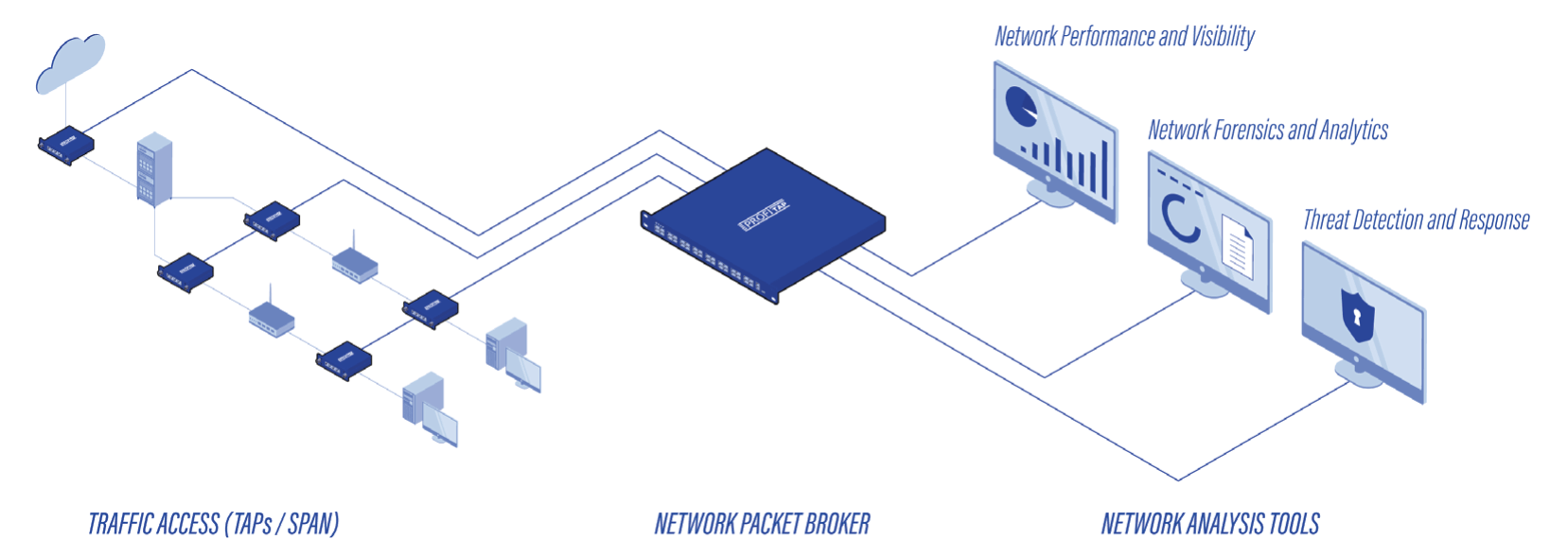
Network Packet Brokers optimize the performance of network analysis and security tools by delivering filtered traffic of interest, helping network engineers to quickly solve application performance bottlenecks and troubleshoot problems on the network.
Optimization of traffic flow between TAP and SPAN connections and network monitoring, and security tools. By maintaining a many-to-many (M:M) port mapping of network ports to monitoring ports, they can direct network traffic efficiently. Filters can be applied to optimize bandwidth usage on the network, and load on connected tools, increasing their performance.
Aggregation, Replication, Advanced Filtering, Load Balancing


Aggregate traffic coming from multiple incoming links
Optimize port, bandwidth, and network tool utilization by consolidating traffic from multiple sources, such as Network TAPs. Aggregation can be combined with the replication feature to send the aggregated traffic to multiple output ports. It can also be combined with both the replication and filtering features to send different parts of the aggregated traffic to different output ports.
Use case examples:
- Send traffic from multiple sources to monitoring and security tools as a single stream
- Aggregate multiple traffic streams into higher-speed links.
Replicate traffic to multiple monitoring and security tools
Traffic replication is the process of making multiple copies of data and forwarding them to different locations, such as NPM/APM tools, network security tools, and data storage.
Benefits of traffic replication include improving the availability of data and increasing the speed of data access.
Use case examples:
- Monitoring (tapping): send the traffic to both its intended destination and monitoring/analysis/storage systems
- Redundancy: send the traffic to multiple network paths to avoid single points of failure and reduce the risks of downtime.
Balance traffic over multiple monitoring and security tools
When several security tools are deployed, load balancing can optimize the response time and avoid uneven load while another is idling. By distributing the traffic load evenly among the available security tools they are used in the most efficient way. A Network Packet Broker is an ideal tool for this as it sits between the TAPs and security tools.
Send only actionable data to each of the connected tools
Ensure optimum efficiency of monitoring and security tools, and bandwidth utilization, by filtering traffic such that only appropriate data is sent to these network tools.
Target specific parts of the traffic via a wide array of filter rules based on L2/L3/L4 packet headers. Filter rules support priority classes, as well as outbound options to apply to the targeted traffic.
